 MANSOQ
 Facility administration
Configure and verify a Laboratory facility
Follow a real synthetic Laboratory setup edit with visible controls, validation and independent saved-record readback; configure clinical services separately.
Current source · Source reviewed; own-facility settings edit observed · 6 min read
Before you begin
- Use an authorized administrator account assigned to the correct facility. The demonstrations used separate synthetic Facility Admin accounts.
- Have an approved facility identity, real address, geographic leaf organization and IANA business timezone. The example uses Asia/Riyadh.
- Do not reuse the synthetic fixture postcode, generic address or contact details for a real facility.
1. Select the correct facility and open General settings
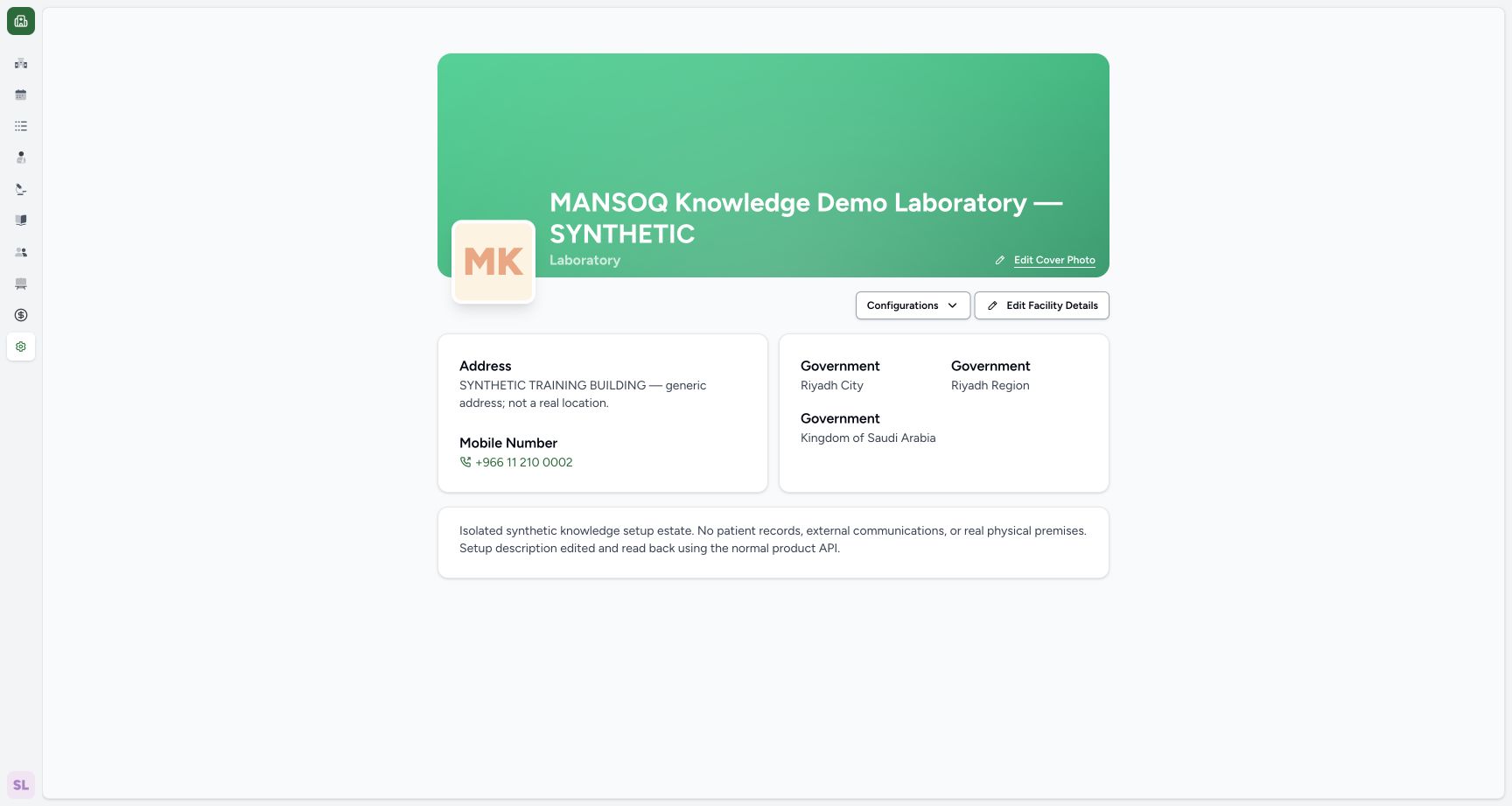
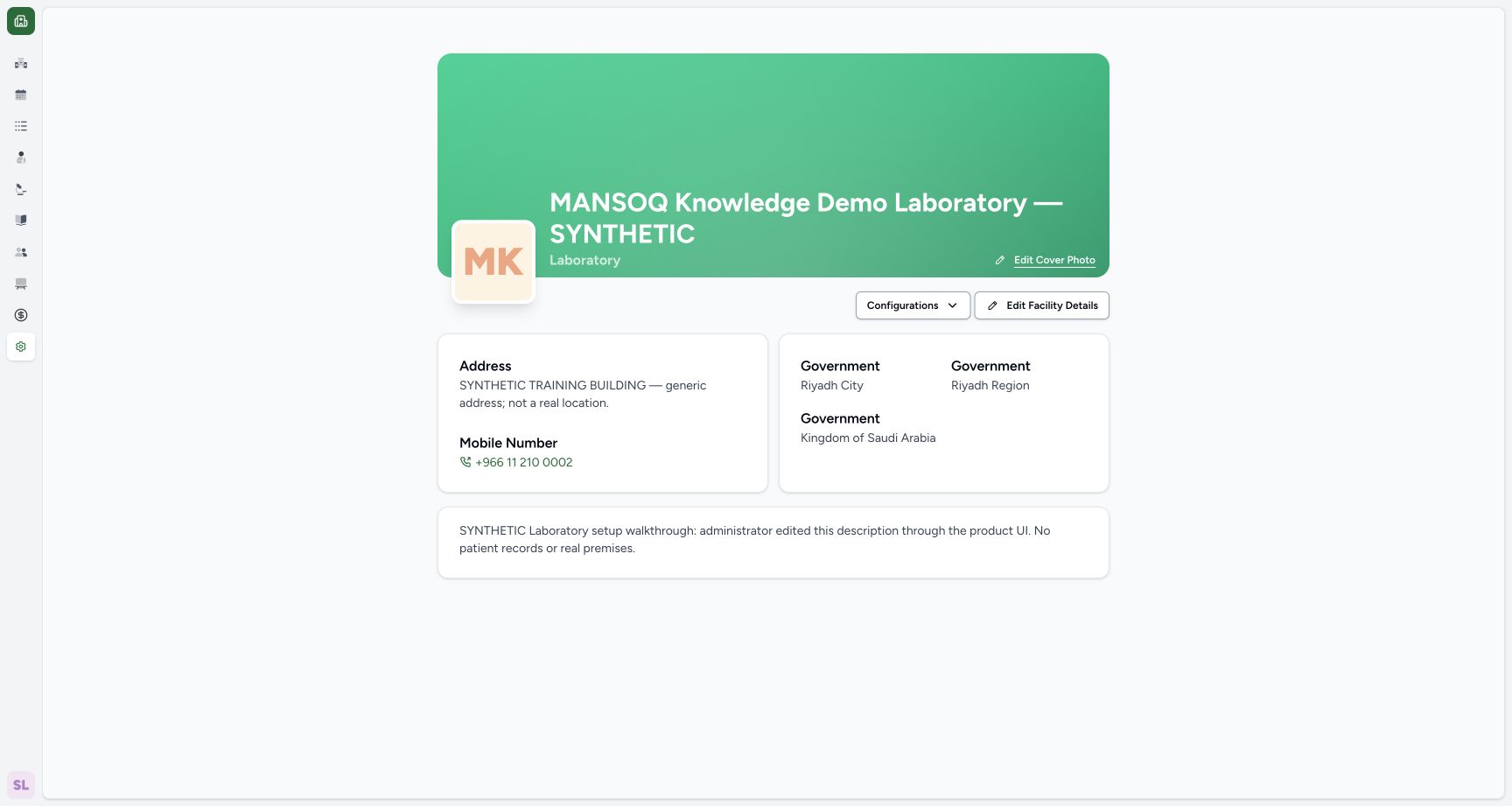
Select the assigned Laboratory facility, expand Settings, and open General. Confirm the facility name and displayed Laboratory classification before editing. The screenshot shows an independently created synthetic estate with no patient records.
2. Edit identity and business timezone
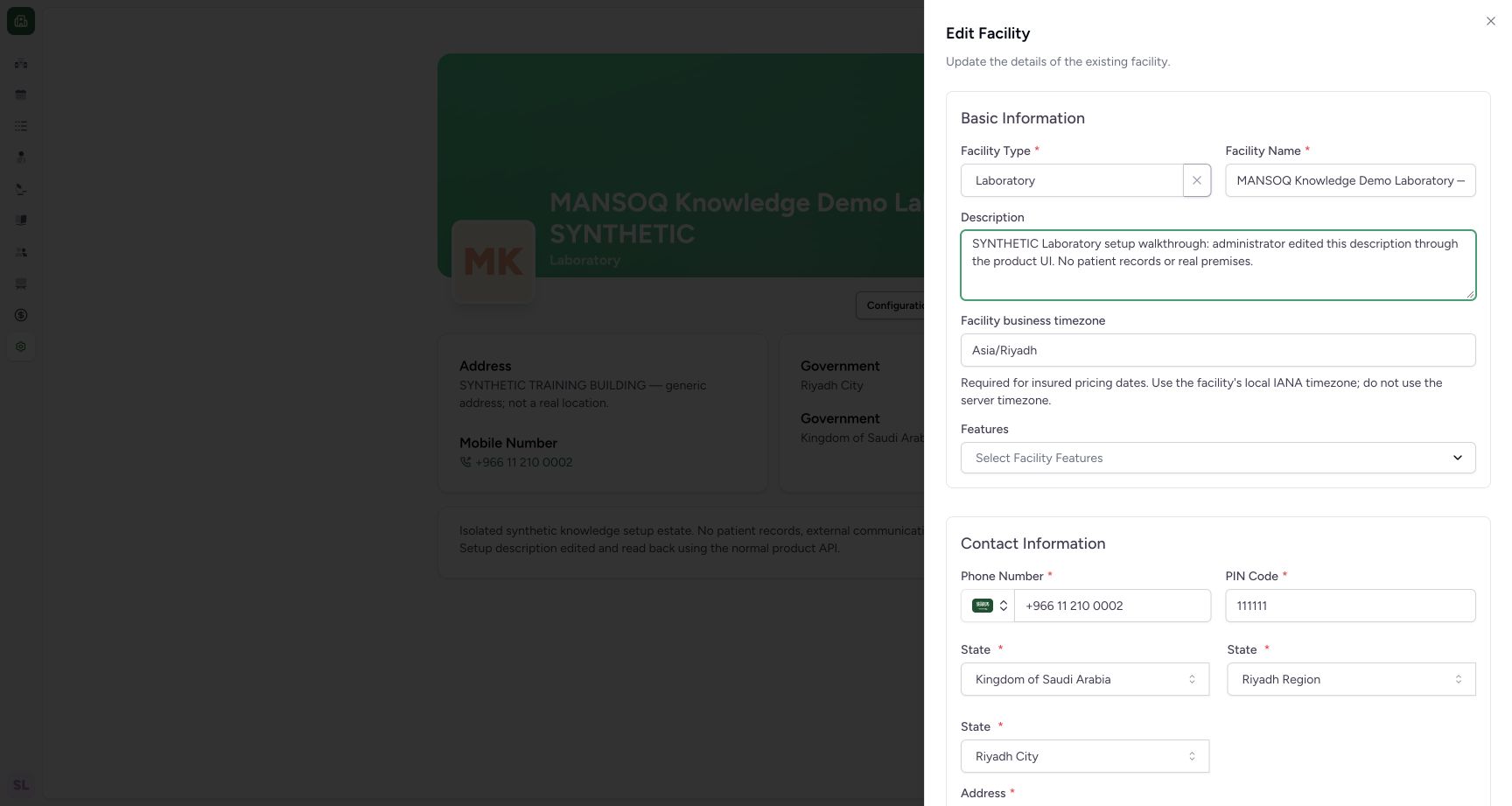
Choose Edit Facility Details. Keep the approved Laboratory type and name, review the description and set the facility’s local IANA business timezone. Review features separately. The source version 2 native code for Laboratory is 14; API writes use the label string, not that integer.
3. Restore the approved Laboratory classification
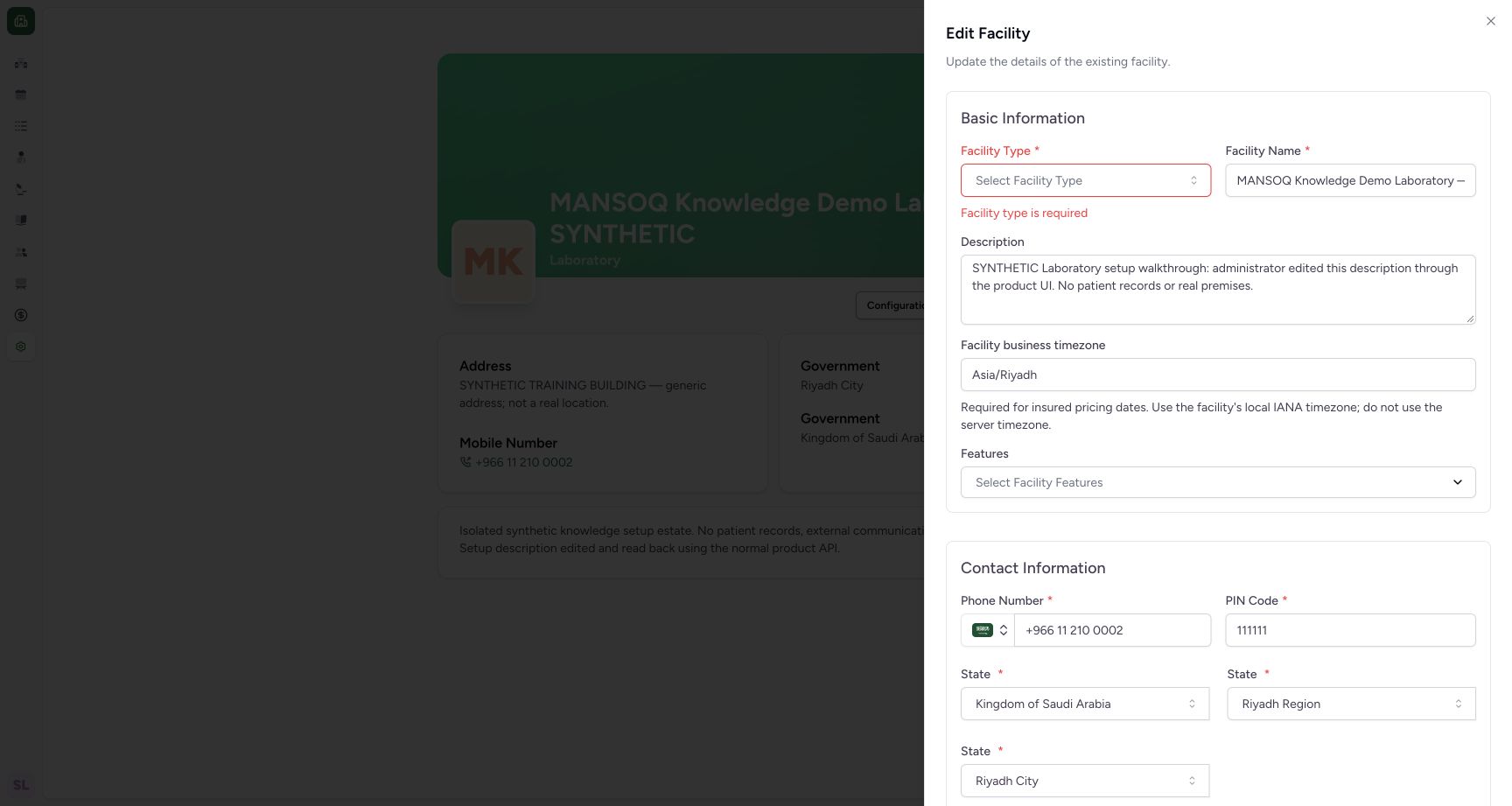
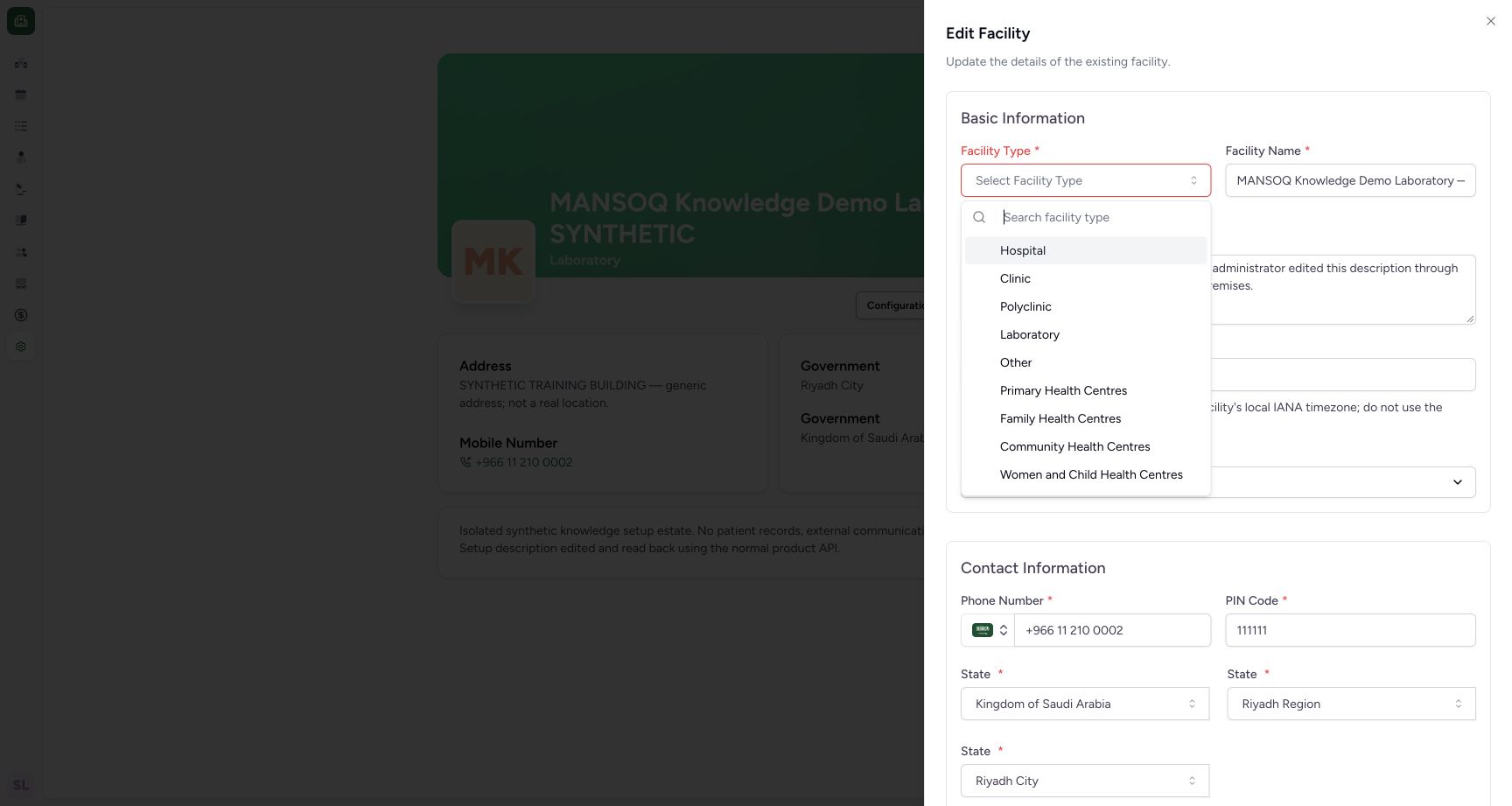
Clearing Facility Type produced Facility type is required. Open the selector and choose Laboratory. The first five entries are the canonical version 2 classifications. The edit selector also retains legacy labels; their presence does not establish additional validated specialist packages.
4. Save valid values and verify the result
Restore the approved values, scroll to the end of the form and select Update Facility. When the edit sheet closes, check the updated description on General settings. An independent normal API read under this estate’s own Facility Admin confirmed the saved text, type, Asia/Riyadh, original features and private directory visibility. The screenshot is the saved result; the shared save-control placement is illustrated in the separate common-form reference.
5. Review the separately configured Lab service
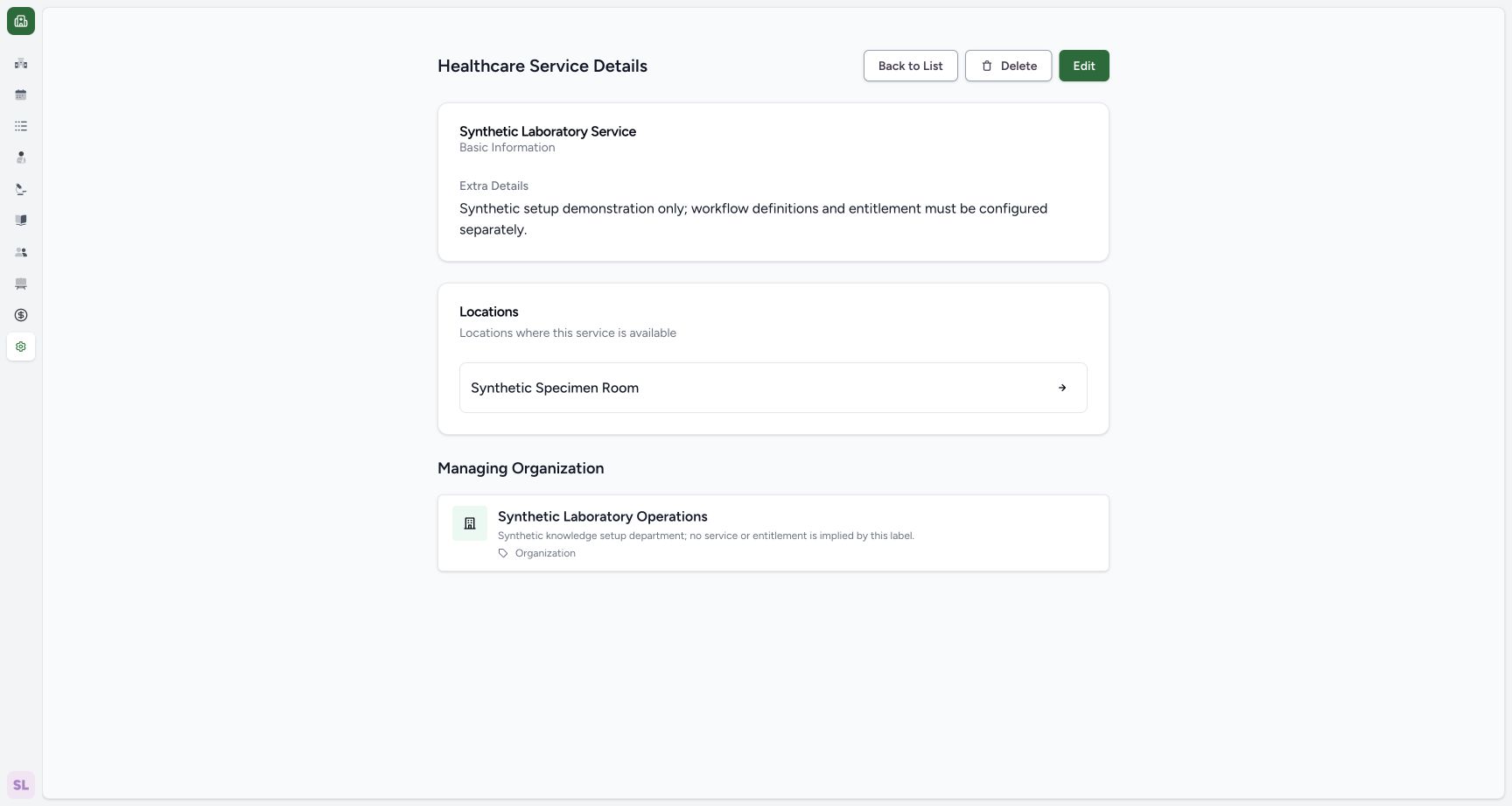
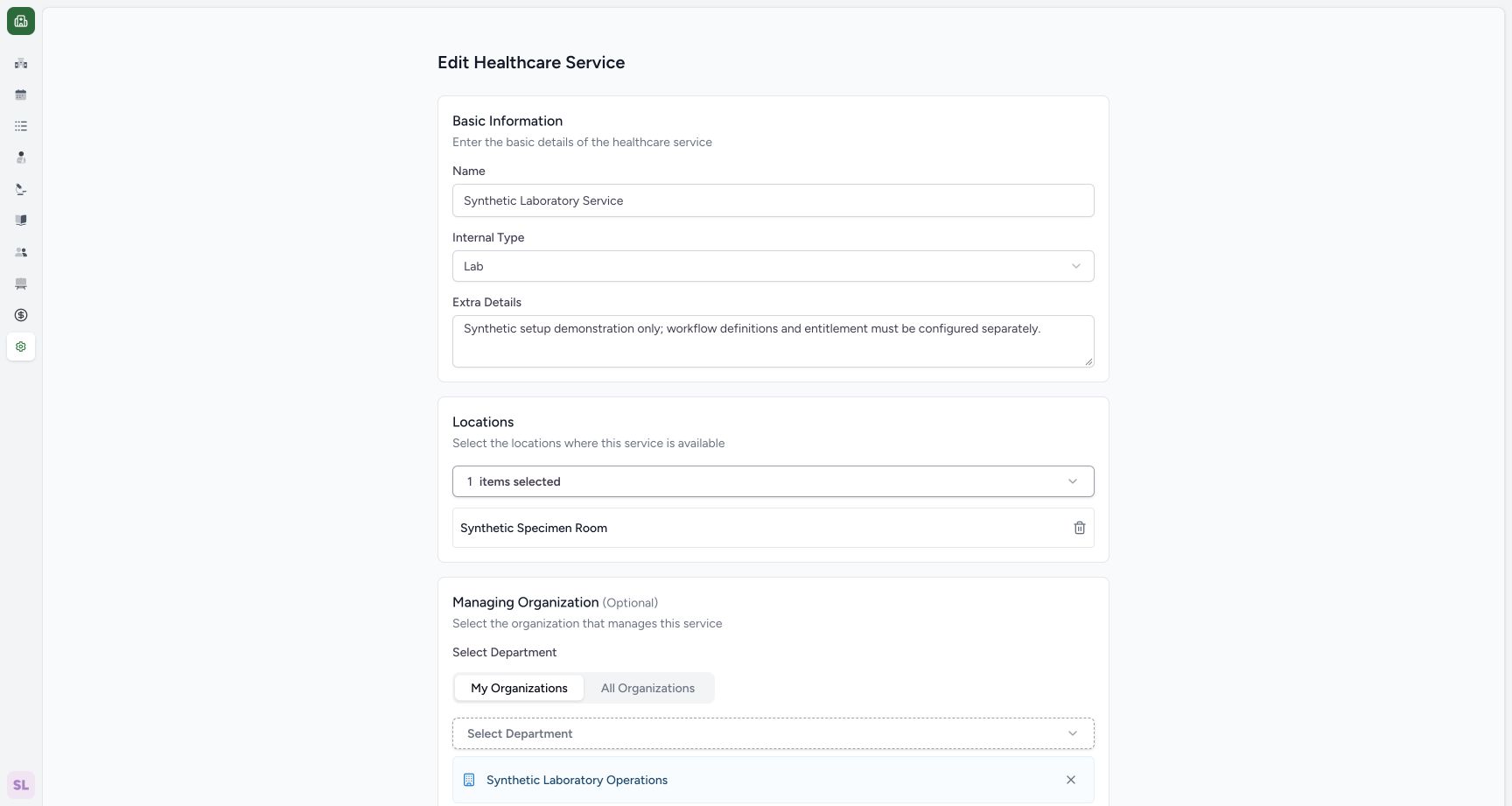
Open Settings → Healthcare Services, select the lab service and choose Edit. Confirm Internal Type: Lab, the intended specimen room and managing department. These are explicit service settings, separate from the facility’s Laboratory classification. Specimen definitions, observation requirements, activity catalogue, results, review and analyzer interfaces still require their own complete workflows.
6. Save and read back a service configuration change
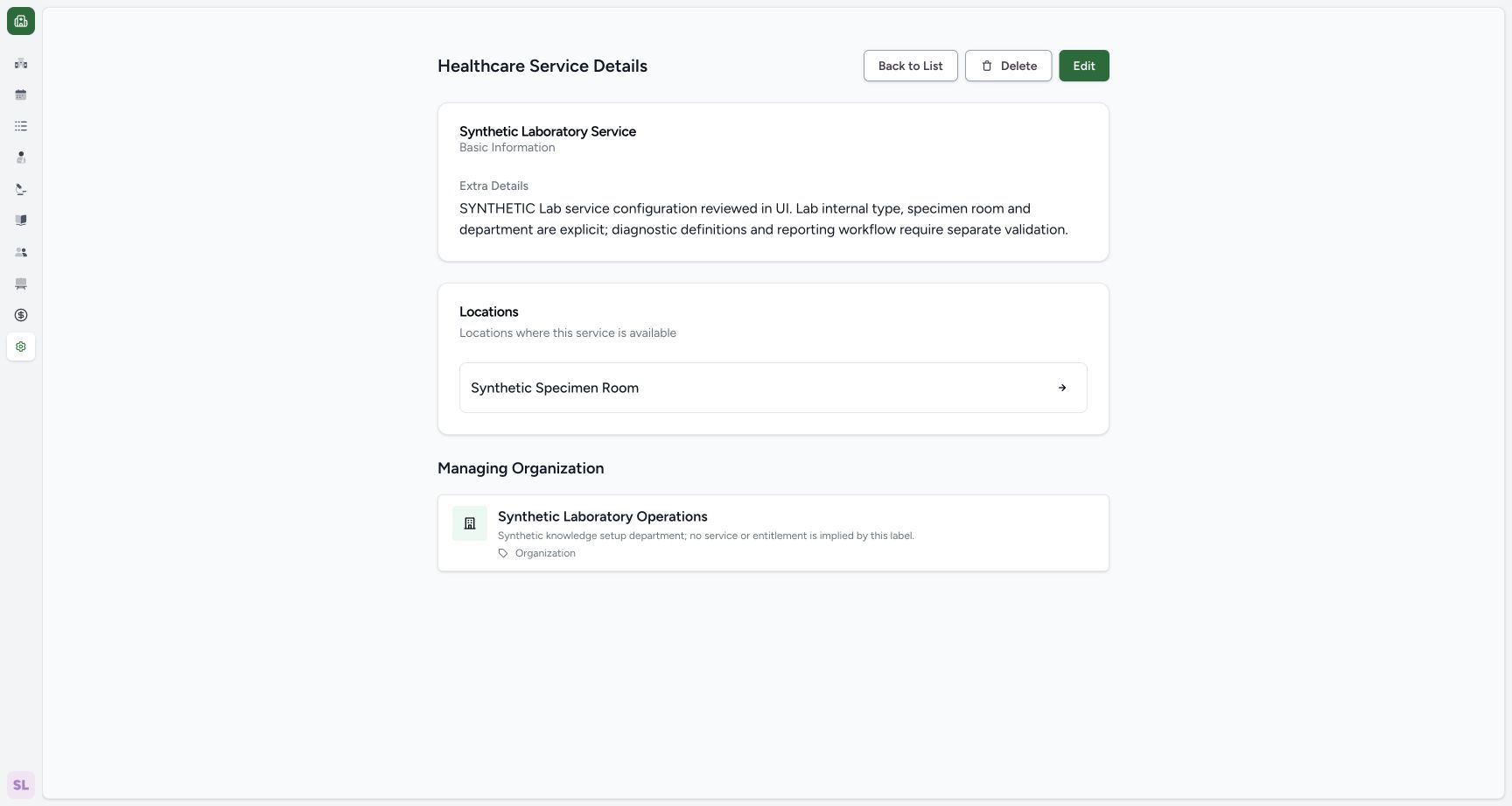
Change only the approved service details and select Save. The demo changed Extra Details through the product UI. The details screen then showed the new explanation. An independent service API GET confirmed the text persisted while internal_type: lab, the specimen-room link and managing department remained unchanged. No diagnostic result or specimen was created in this setup check.
What was created and independently verified
This Laboratory estate was created through the normal product POST /api/v1/facility/ API, which returned 200 in this isolated deployment. A separate facility GET and read-only native-code check confirmed Laboratory / 14 and Asia/Riyadh. Its own department, locations, service and Facility Admin membership were then created through normal product APIs and read back. The settings edit shown above was performed through the actual application UI. Organization-screen facility creation was not captured by this walkthrough; that UI flow remains open.
Classification does not enable a module
The same shared navigation and setup components were observed across the five estates. A facility label alone does not prove that appointments, inpatient care, diagnostics, pharmacy, NPHIES, claims or finance are operational. Validate the configured service internal types, departments, locations, catalogues, deployment settings and role permissions for each intended workflow.
Address, maps and visibility
The current shared form requires a six-digit PIN Code and, in this synthetic geographic hierarchy, repeats the State label for country, region and city selectors. Check the selected geographic names. External map tiles and lookup were restricted in the isolated preview and were not qualified. Make this facility public controls facility-directory discoverability, not access to the knowledge website. Review it explicitly: the create-form defaults and existing-facility edit values can differ.
Evidence scope
The captured operation is an own-facility administrator settings edit and the specific extra screens described below. Positive own-facility reads and a negative read of the protected training Polyclinic were observed for all five accounts. These observations do not close the full role boundary, facility, medical, nonmedical or workflow matrix. No complete end-to-end clinical qualification is asserted.
Troubleshooting
The field is valid locally but the server rejects the save
Read the actual validation message, verify the facility, approved unique name and geographic leaf, and keep the existing record unchanged until the problem is resolved. Do not bypass API validation.
A required postcode does not match the real address format
The observed form currently enforces six digits. Escalate deployment localization; do not invent a real-facility address or copy the training placeholder.
Source evidence
References are pinned to the private MANSOQ source repository. Repository access is required to open these links.
- repositories/platform/mansoq-core/mansoq/facility/setup_types.py:5 · f6e9f05f
- repositories/platform/mansoq-web/src/components/Facility/FacilityForm.tsx:61 · f6e9f05f
- repositories/platform/mansoq-web/src/components/Facility/FacilityForm.tsx:169 · f6e9f05f
- repositories/platform/mansoq-web/src/types/facility/facility.ts:188 · f6e9f05f
- repositories/platform/mansoq-web/src/Utils/validators.ts:34 · f6e9f05f
- repositories/platform/mansoq-core/mansoq/emr/resources/facility/spec.py:100 · f6e9f05f
- repositories/platform/mansoq-core/mansoq/emr/api/viewsets/facility_organization.py:65 · f6e9f05f
- repositories/platform/mansoq-core/mansoq/emr/resources/location/spec.py:40 · f6e9f05f
- repositories/platform/mansoq-core/mansoq/emr/resources/healthcare_service/spec.py:18 · f6e9f05f