 MANSOQ
 Clinical care
Record a coded symptom with onset, severity and verification
Create and verify a structured symptom entry while reviewing defaults, onset, clinical status, severity and verification separately.
8 min read · Source baseline f6e9f05f
Verification and applicability
source reviewed
Check your installed version, permissions and local configuration.
Before you begin
- Verify the patient, active primary encounter, clinical-write permission and the facility’s approved documentation process. The observed account is Nurse in an Inpatient encounter at a synthetic Polyclinic.
- Use a configured, validated condition terminology. The pictured LOW BACK PAIN entry is a fictional software exercise; it does not establish a real complaint, assessment, diagnosis or treatment.
1. Open the symptom workflow in the intended encounter
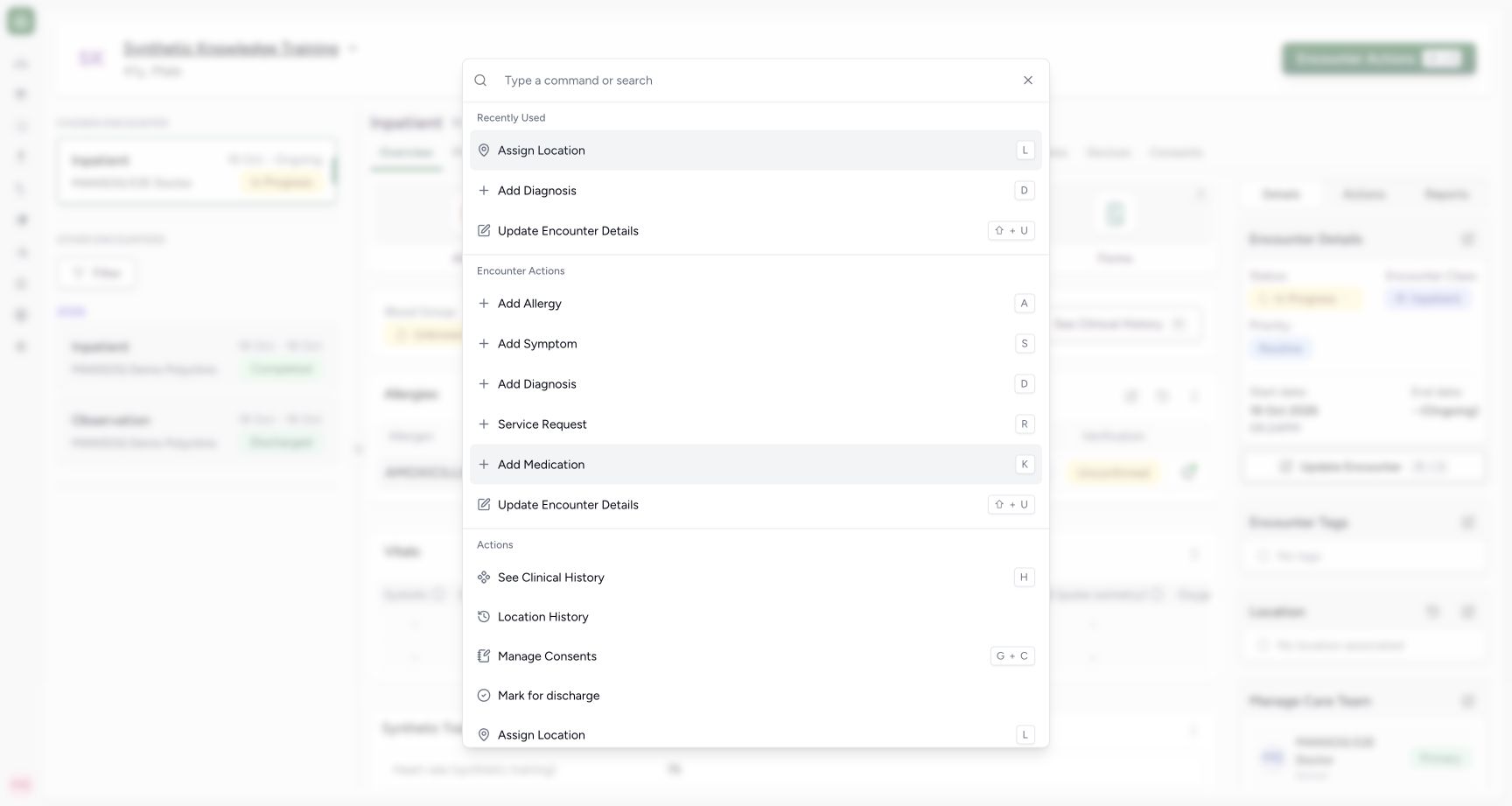
Check the patient banner and active encounter. Open Encounter Actions → Add Symptom. The menu also contains Add Diagnosis, a separate action. This guide creates a problem-list symptom entry; it does not replace the encounter diagnosis workflow.
 12
12Capture details
Actual Nurse in original pinned production UI, isolated synthetic active Inpatient encounter in a Polyclinic. One ICD-10-AM M54.5 problem-list symptom saved Active/Mild/Unconfirmed with fictional onset and note. No real patient assessment or treatment decision; two existing encounter diagnoses unchanged. This does not qualify every role, facility or symptom branch. Start: Nurse opens Encounter Actions on active primary Inpatient encounter and selects Add Symptom. This documents a problem-list symptom separately from encounter diagnosis.
- Start symptom documentation: Start symptom documentation
- Diagnosis is a separate structured workflow: Diagnosis is a separate structured workflow
2. Identify the structured form and prior-history option
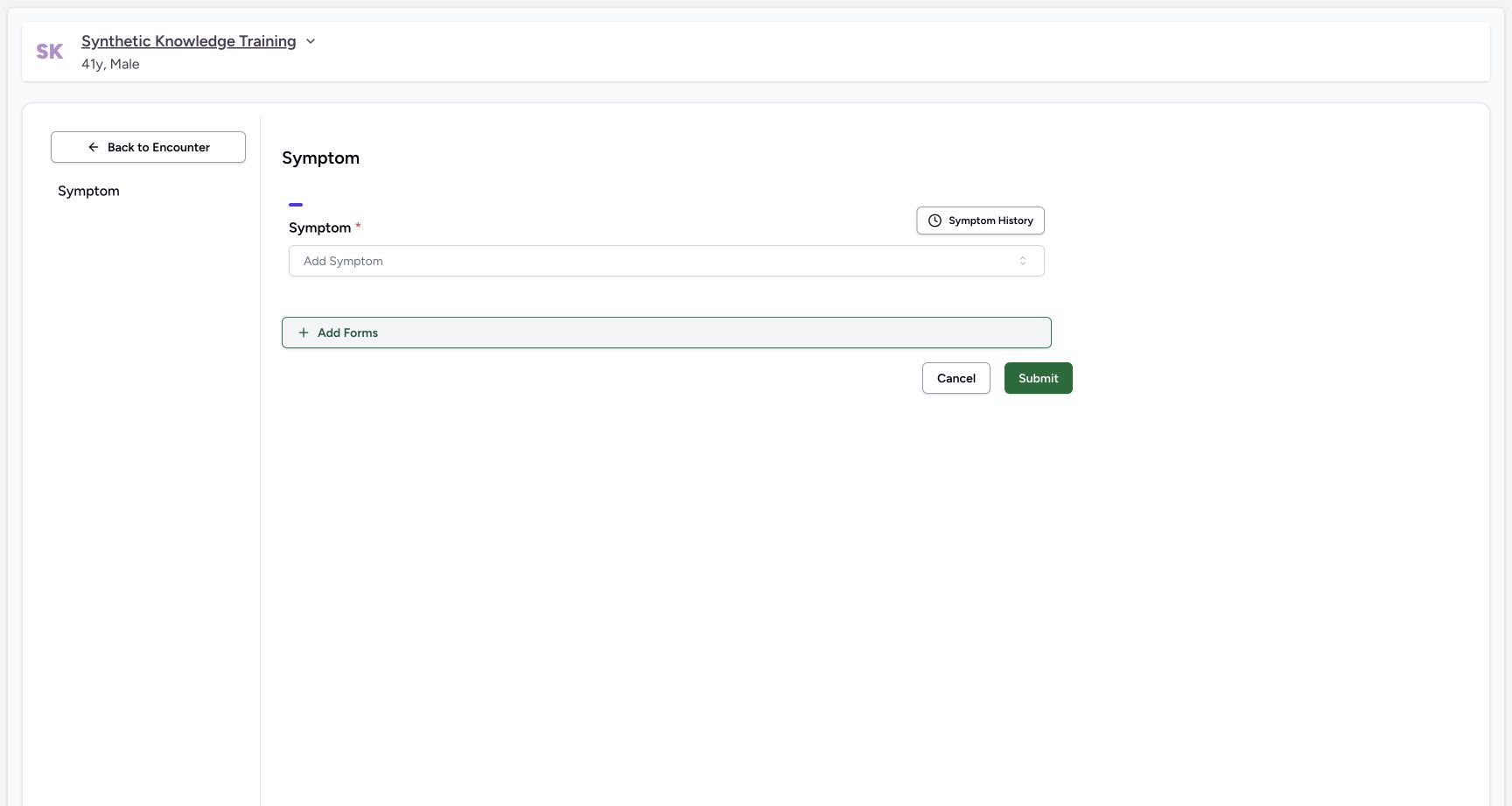
The Symptom form starts with Add Symptom, Symptom History, Cancel and Submit. A blank form means that no current rows have loaded for this encounter; it is not a documented negative clinical finding. The history-copy workflow is a separate branch and is not demonstrated by merely opening this form.
 12
12Capture details
Actual Nurse in original pinned production UI, isolated synthetic active Inpatient encounter in a Polyclinic. One ICD-10-AM M54.5 problem-list symptom saved Active/Mild/Unconfirmed with fictional onset and note. No real patient assessment or treatment decision; two existing encounter diagnoses unchanged. This does not qualify every role, facility or symptom branch. Start: Empty structured Symptom form offers Symptom History and Add Symptom; no symptom record yet exists. A blank view is not a clinical negative finding.
- Review patient-wide prior symptom records: Review patient-wide prior symptom records
- Choose a coded symptom: Choose a coded symptom
3. Select the appropriate coded symptom
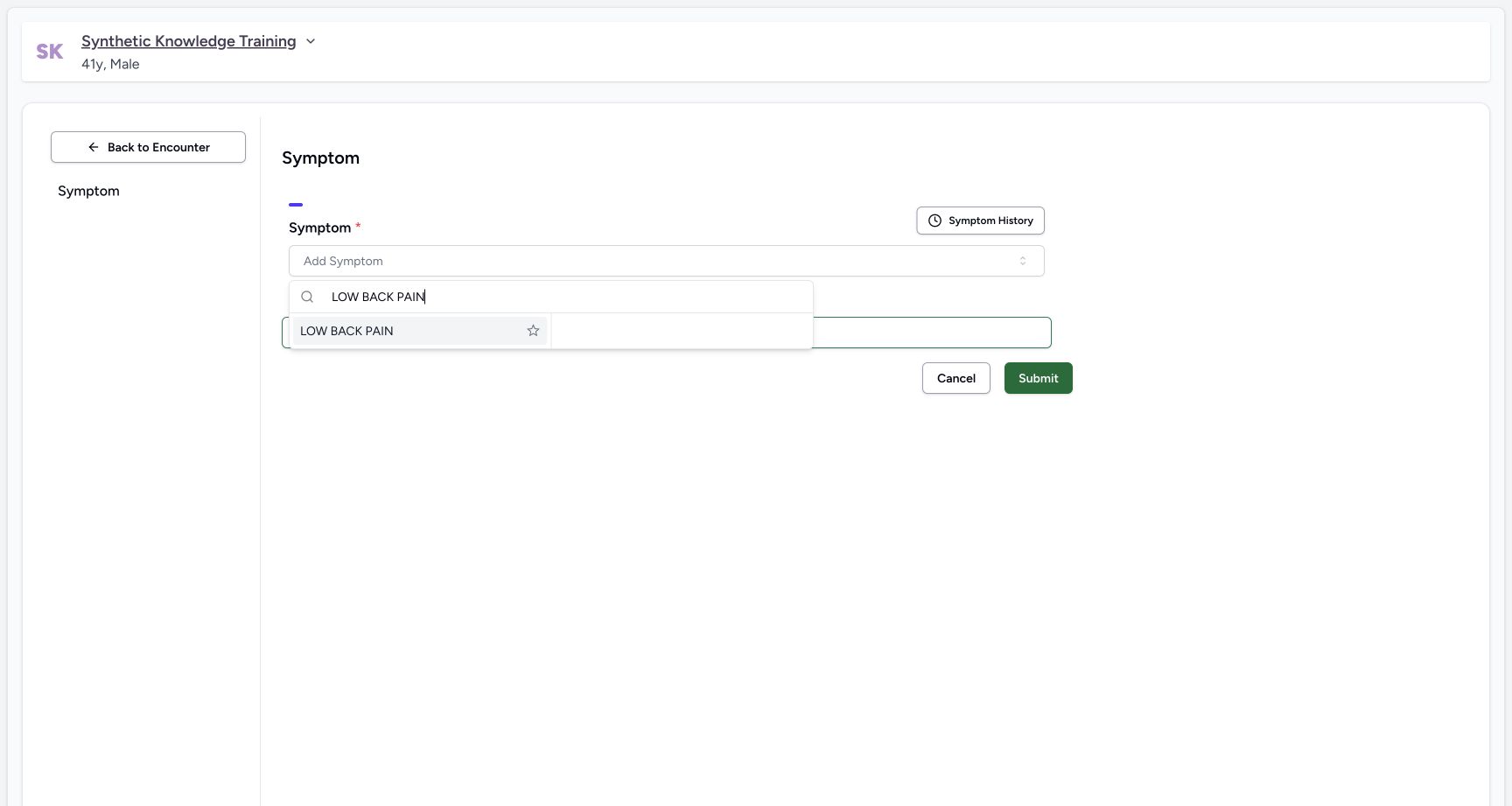
Open Add Symptom, search the facility’s configured condition terminology and choose the intended coded result. The example selects LOW BACK PAIN, an already installed and normally validated ICD-10-AM M54.5 concept. Choosing a term creates a pending form row, not a saved diagnosis or symptom.
 12
12Capture details
Actual Nurse in original pinned production UI, isolated synthetic active Inpatient encounter in a Polyclinic. One ICD-10-AM M54.5 problem-list symptom saved Active/Mild/Unconfirmed with fictional onset and note. No real patient assessment or treatment decision; two existing encounter diagnoses unchanged. This does not qualify every role, facility or symptom branch. Action: LOW BACK PAIN returns existing installed ICD-10-AM M54.5 concept. Normal ValueSet expansion and code validation passed; no new terminology or validation bypass was configured.
- Search the configured condition terminology: Search the configured condition terminology
- Choose the verified coded symptom: Choose the verified coded symptom
 12
12Capture details
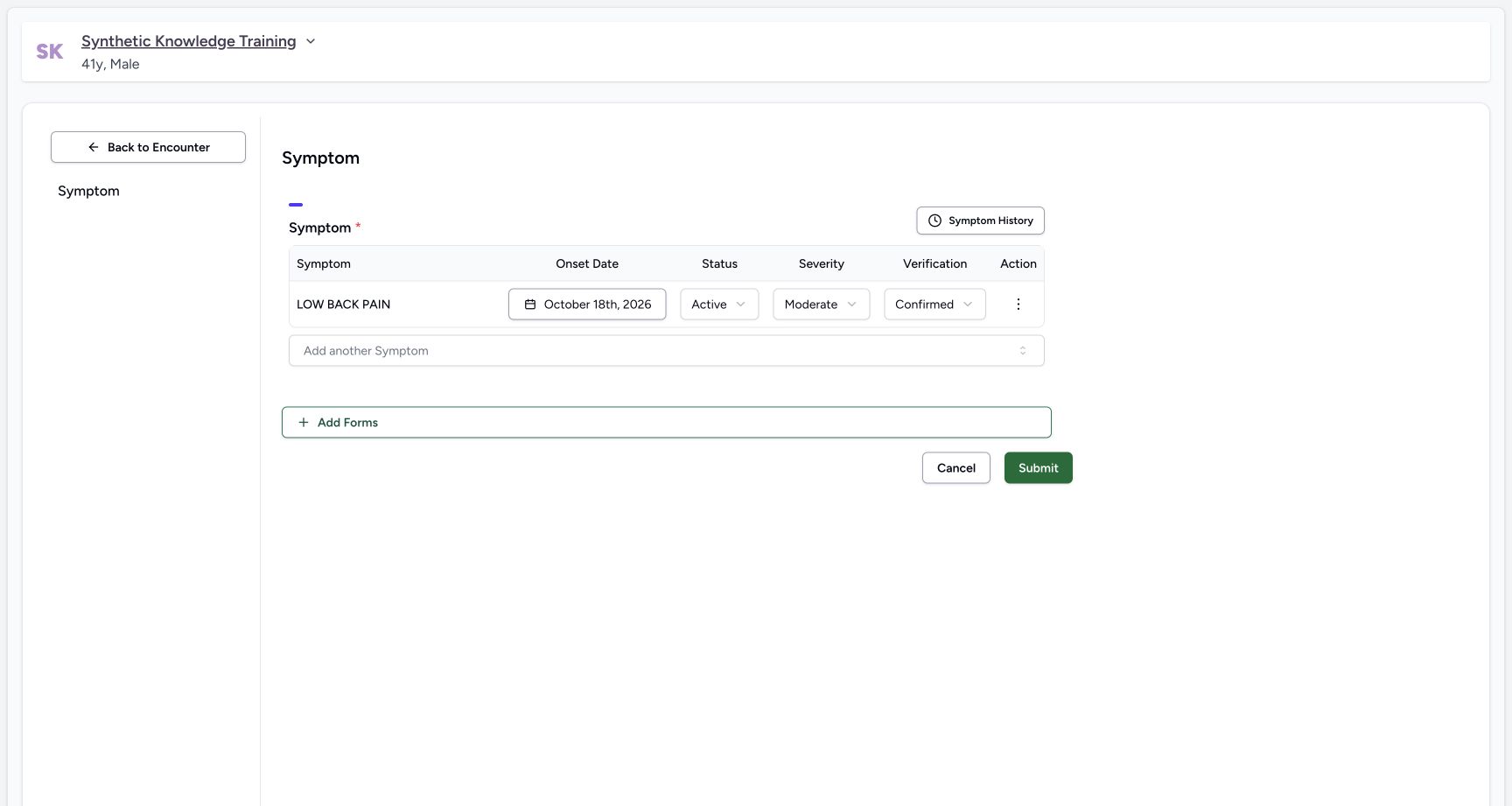
Actual Nurse in original pinned production UI, isolated synthetic active Inpatient encounter in a Polyclinic. One ICD-10-AM M54.5 problem-list symptom saved Active/Mild/Unconfirmed with fictional onset and note. No real patient assessment or treatment decision; two existing encounter diagnoses unchanged. This does not qualify every role, facility or symptom branch. Action: New coded symptom defaults to today, Active, Moderate and Confirmed; these defaults must be reviewed rather than treated as assessed clinical facts. No record has been saved.
- Review onset, status, severity and verification before saving: Review onset, status, severity and verification before saving
- A default verification value is not clinical confirmation: A default verification value is not clinical confirmation
4. Review every default before documenting
A new row initially shows today’s onset, Active, Moderate and Confirmed. These are software defaults and must be reviewed against the authorized documentation. Clinical status, severity and verification are separate fields; an automatic Confirmed value does not establish clinical confirmation.
12Capture details
Actual Nurse in original pinned production UI, isolated synthetic active Inpatient encounter in a Polyclinic. One ICD-10-AM M54.5 problem-list symptom saved Active/Mild/Unconfirmed with fictional onset and note. No real patient assessment or treatment decision; two existing encounter diagnoses unchanged. This does not qualify every role, facility or symptom branch. Action: New coded symptom defaults to today, Active, Moderate and Confirmed; these defaults must be reviewed rather than treated as assessed clinical facts. No record has been saved.
- Review onset, status, severity and verification before saving: Review onset, status, severity and verification before saving
- A default verification value is not clinical confirmation: A default verification value is not clinical confirmation
5. Set severity and verification deliberately
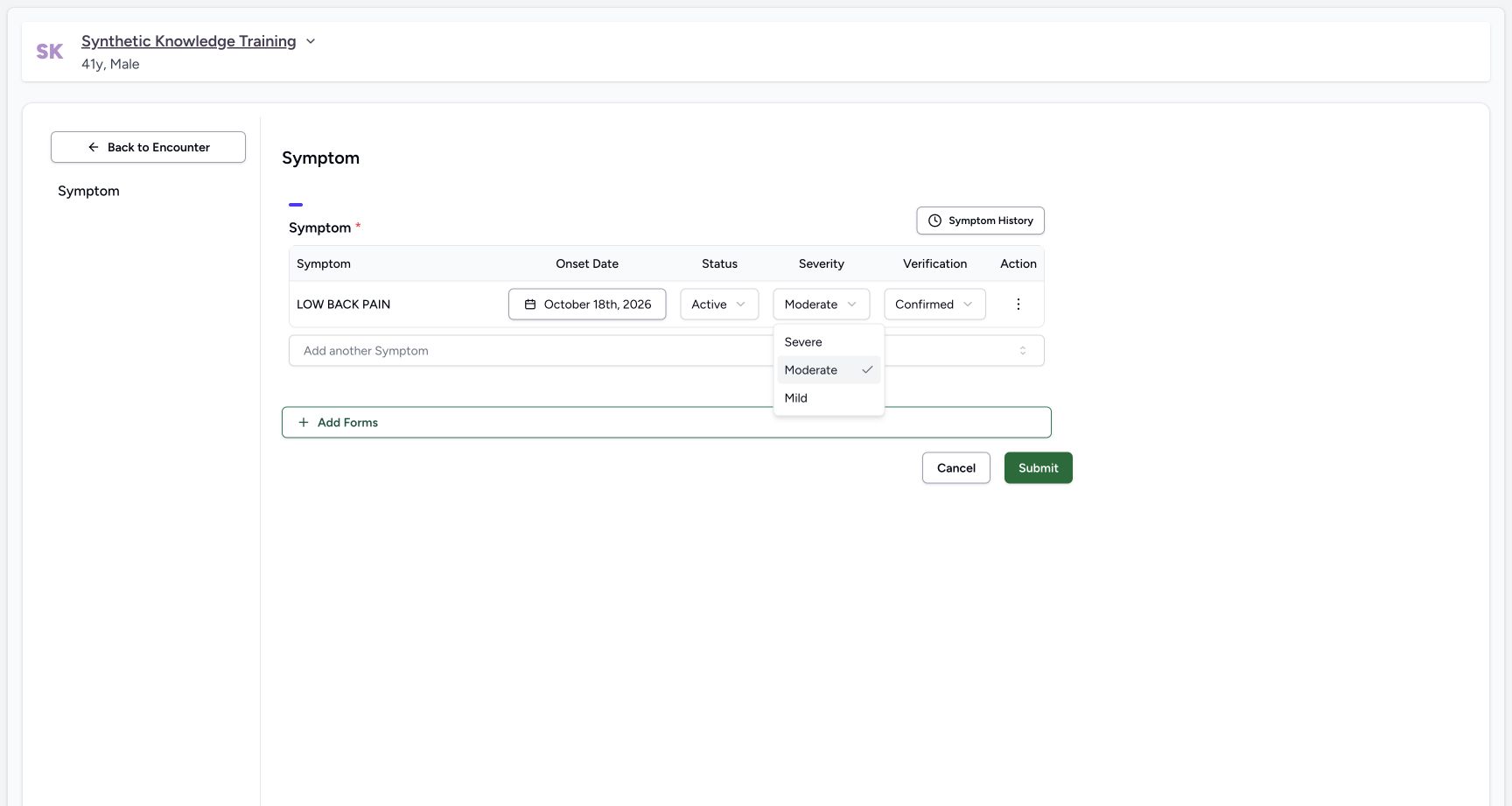
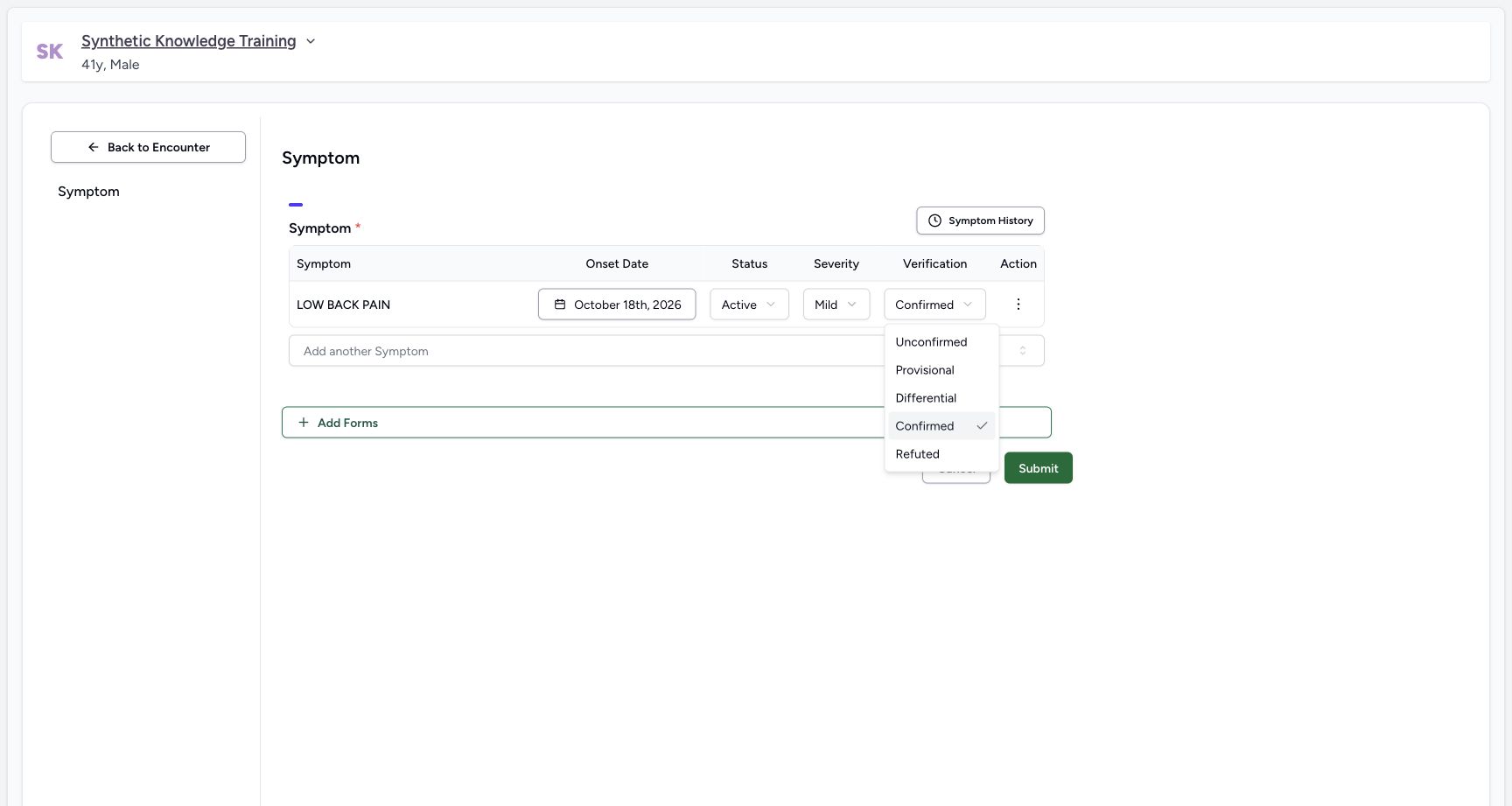
Open Severity to see Severe, Moderate and Mild. Open Verification to see Unconfirmed, Provisional, Differential, Confirmed and Refuted for a new row. The fictional example chooses Mild and Unconfirmed. Select values only from the documented assessment and the facility’s approved process; these screenshots teach controls, not clinical grading.
 1
1Capture details
Actual Nurse in original pinned production UI, isolated synthetic active Inpatient encounter in a Polyclinic. One ICD-10-AM M54.5 problem-list symptom saved Active/Mild/Unconfirmed with fictional onset and note. No real patient assessment or treatment decision; two existing encounter diagnoses unchanged. This does not qualify every role, facility or symptom branch. Action: Severity menu offers Severe, Moderate and Mild; Mild is selected only as a fictional software exercise, not clinical grading advice.
- Select the documented severity: Select the documented severity
 1
1Capture details
Actual Nurse in original pinned production UI, isolated synthetic active Inpatient encounter in a Polyclinic. One ICD-10-AM M54.5 problem-list symptom saved Active/Mild/Unconfirmed with fictional onset and note. No real patient assessment or treatment decision; two existing encounter diagnoses unchanged. This does not qualify every role, facility or symptom branch. Action: New symptom verification offers Unconfirmed, Provisional, Differential, Confirmed and Refuted; Entered in Error is reserved for existing records. Fictional exercise chooses Unconfirmed.
- Verification is separate from clinical status and severity: Verification is separate from clinical status and severity
6. Choose and review the onset date
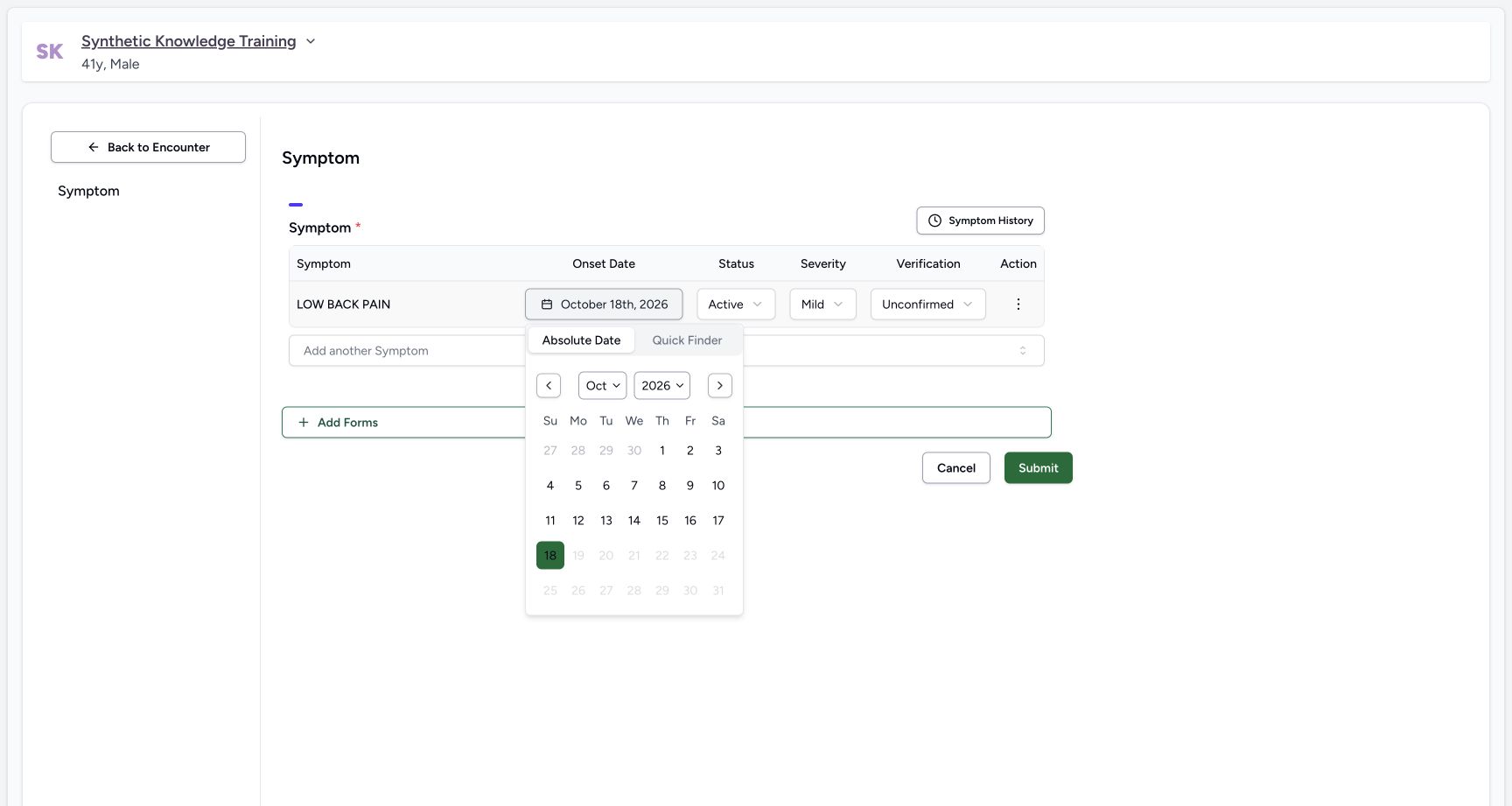
Open Onset Date and choose the documented past or current date. The pictured calendar still highlights 18 October before 17 October is chosen; future dates are disabled. The subsequent draft shows October 17th, 2026. Review the displayed date before saving rather than relying on the calendar’s initially selected day.
 12
12Capture details
Actual Nurse in original pinned production UI, isolated synthetic active Inpatient encounter in a Polyclinic. One ICD-10-AM M54.5 problem-list symptom saved Active/Mild/Unconfirmed with fictional onset and note. No real patient assessment or treatment decision; two existing encounter diagnoses unchanged. This does not qualify every role, facility or symptom branch. Action: Onset picker shows 18 October selected before choosing 17 October for the fictional exercise. Future dates are visibly disabled. The subsequent reviewed draft and saved readback establish the final 17 October onset.
- Choose the documented onset date: Choose the documented onset date
- Future onset dates are disabled: Future onset dates are disabled
 12
12Capture details
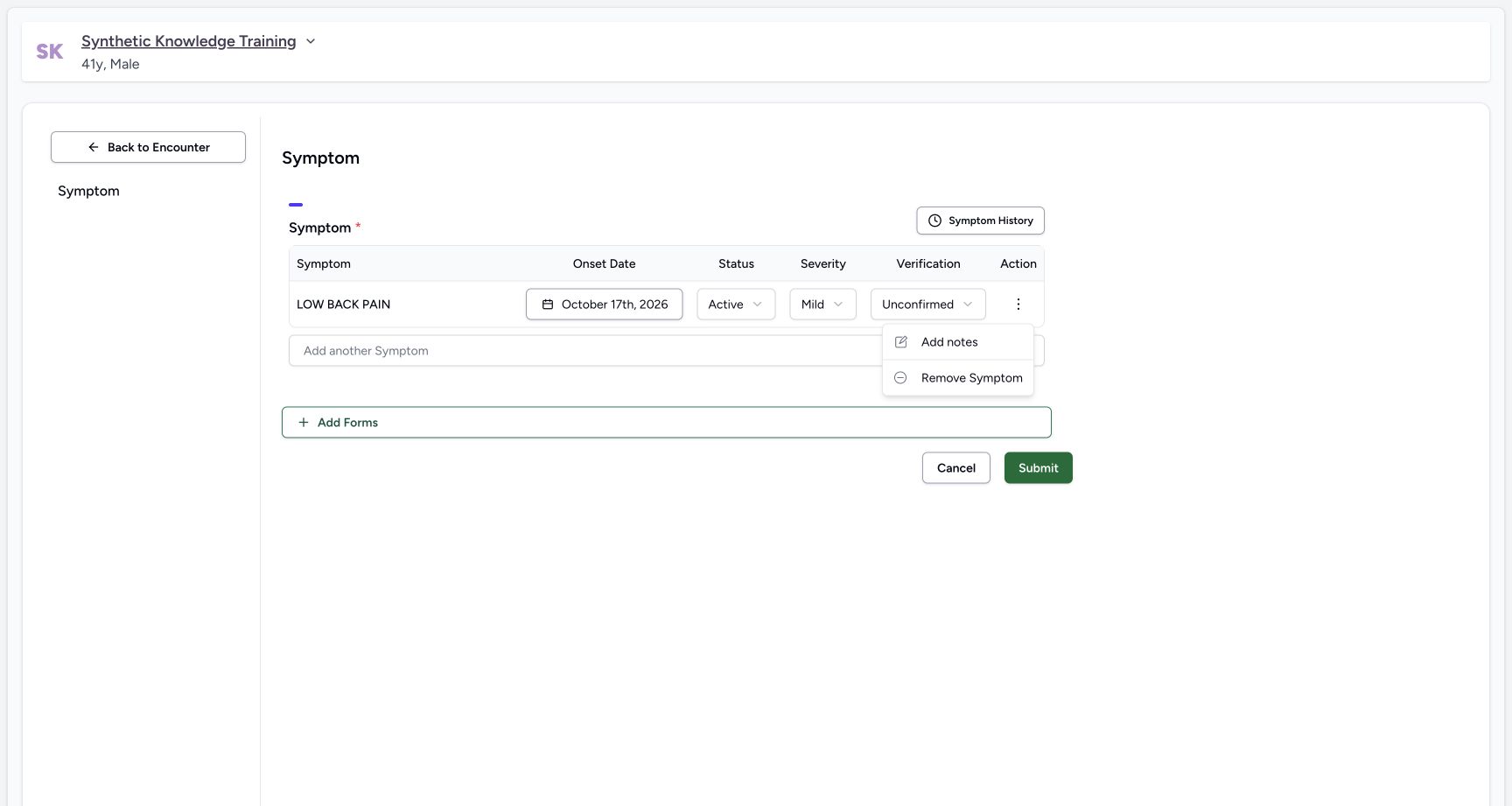
Actual Nurse in original pinned production UI, isolated synthetic active Inpatient encounter in a Polyclinic. One ICD-10-AM M54.5 problem-list symptom saved Active/Mild/Unconfirmed with fictional onset and note. No real patient assessment or treatment decision; two existing encounter diagnoses unchanged. This does not qualify every role, facility or symptom branch. Action: Symptom row actions expose Add notes and Remove Symptom. Removing a new unsaved row discards the draft; removing an existing record prepares entered-in-error verification rather than deletion.
- Add explanatory symptom context: Add explanatory symptom context
- Removal behavior depends on new versus saved record: Removal behavior depends on new versus saved record
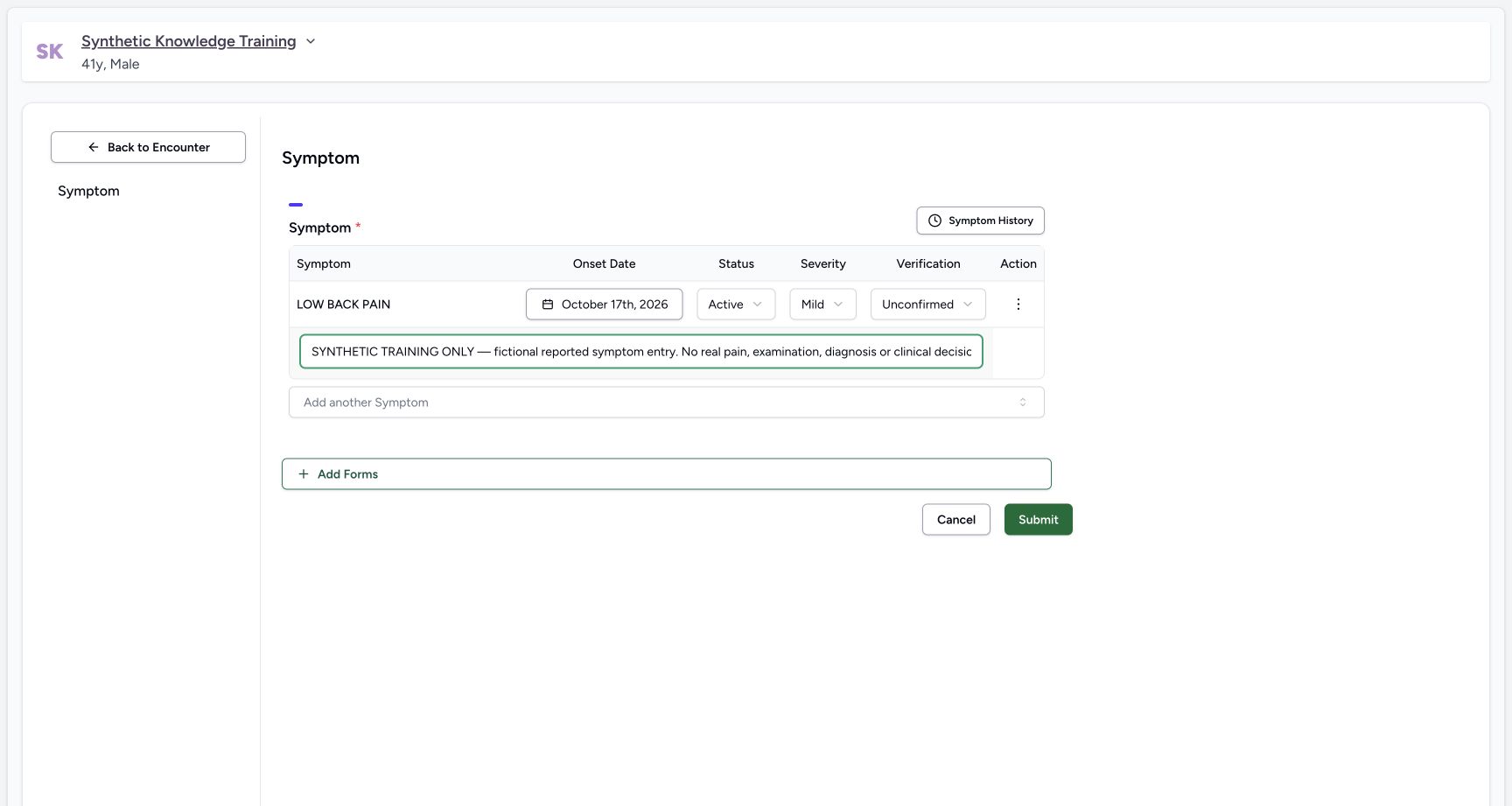 123
123Capture details
Actual Nurse in original pinned production UI, isolated synthetic active Inpatient encounter in a Polyclinic. One ICD-10-AM M54.5 problem-list symptom saved Active/Mild/Unconfirmed with fictional onset and note. No real patient assessment or treatment decision; two existing encounter diagnoses unchanged. This does not qualify every role, facility or symptom branch. Action: Draft reviewed with genuine M54.5 code, fictional17October onset, Active/Mild/Unconfirmed and explicit synthetic note. No symptom record is saved until Submit.
- Review the intended code and assessment fields: Review the intended code and assessment fields
- Keep the reported context and source clear: Keep the reported context and source clear
- Persist the reviewed structured symptom: Persist the reviewed structured symptom
7. Add context and review the complete pending row
Open the row’s three-dot action menu and choose Add notes. Enter the appropriate source and context, then review the term, onset, status, severity, verification and note together. The example note explicitly identifies the fictional software exercise. Remove Symptom is also in this menu; do not use it unintentionally. Draft removal and correction of saved records are separate behaviors.
12Capture details
Actual Nurse in original pinned production UI, isolated synthetic active Inpatient encounter in a Polyclinic. One ICD-10-AM M54.5 problem-list symptom saved Active/Mild/Unconfirmed with fictional onset and note. No real patient assessment or treatment decision; two existing encounter diagnoses unchanged. This does not qualify every role, facility or symptom branch. Action: Symptom row actions expose Add notes and Remove Symptom. Removing a new unsaved row discards the draft; removing an existing record prepares entered-in-error verification rather than deletion.
- Add explanatory symptom context: Add explanatory symptom context
- Removal behavior depends on new versus saved record: Removal behavior depends on new versus saved record
123Capture details
Actual Nurse in original pinned production UI, isolated synthetic active Inpatient encounter in a Polyclinic. One ICD-10-AM M54.5 problem-list symptom saved Active/Mild/Unconfirmed with fictional onset and note. No real patient assessment or treatment decision; two existing encounter diagnoses unchanged. This does not qualify every role, facility or symptom branch. Action: Draft reviewed with genuine M54.5 code, fictional17October onset, Active/Mild/Unconfirmed and explicit synthetic note. No symptom record is saved until Submit.
- Review the intended code and assessment fields: Review the intended code and assessment fields
- Keep the reported context and source clear: Keep the reported context and source clear
- Persist the reviewed structured symptom: Persist the reviewed structured symptom
8. Submit and verify the saved symptom
Select Submit, then verify the Symptoms section on encounter Overview. The example shows LOW BACK PAIN, Mild, Active and Unconfirmed. Independent readback confirms one saved problem-list item on this encounter, the exact 17 October onset and the synthetic note, while two prior encounter diagnoses remain unchanged. Continue to the history guide to inspect the absolute onset, author, saved note and source encounter.
123Capture details
Actual Nurse in original pinned production UI, isolated synthetic active Inpatient encounter in a Polyclinic. One ICD-10-AM M54.5 problem-list symptom saved Active/Mild/Unconfirmed with fictional onset and note. No real patient assessment or treatment decision; two existing encounter diagnoses unchanged. This does not qualify every role, facility or symptom branch. Action: Draft reviewed with genuine M54.5 code, fictional17October onset, Active/Mild/Unconfirmed and explicit synthetic note. No symptom record is saved until Submit.
- Review the intended code and assessment fields: Review the intended code and assessment fields
- Keep the reported context and source clear: Keep the reported context and source clear
- Persist the reviewed structured symptom: Persist the reviewed structured symptom
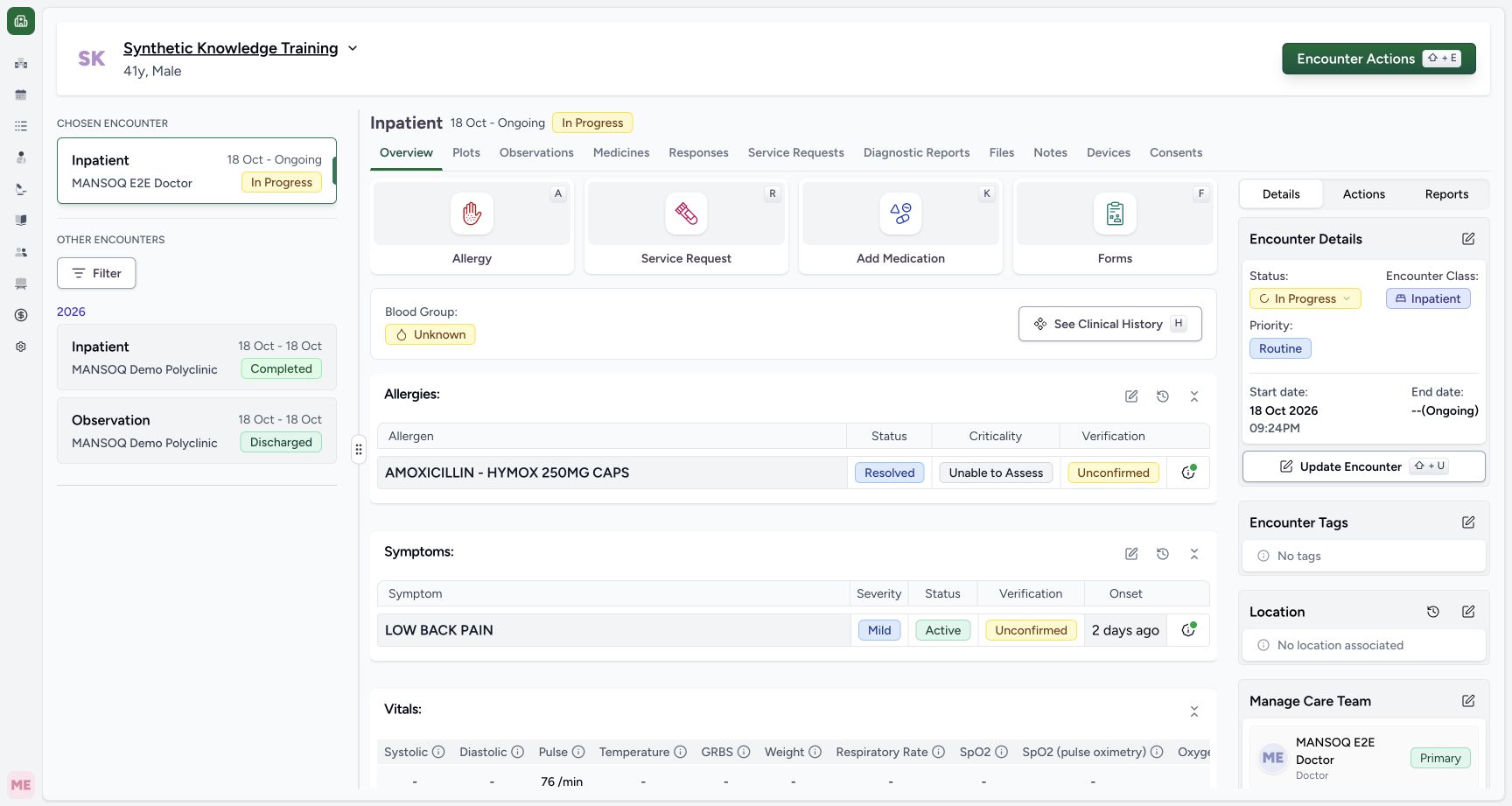 123
123Capture details
Actual Nurse in original pinned production UI, isolated synthetic active Inpatient encounter in a Polyclinic. One ICD-10-AM M54.5 problem-list symptom saved Active/Mild/Unconfirmed with fictional onset and note. No real patient assessment or treatment decision; two existing encounter diagnoses unchanged. This does not qualify every role, facility or symptom branch. Success: Active encounter summary shows one LOW BACK PAIN symptom with Mild/Active/Unconfirmed and relative onset. Independent READ ONLY confirms sameNurse-created M54.5 problem_list_item, exact17October onset and synthetic note; two prior encounter diagnoses unchanged.
- Saved symptom is separate from encounter diagnoses: Saved symptom is separate from encounter diagnoses
- Open patient-wide symptom history for source context: Open patient-wide symptom history for source context
- Relative time is a display; verify the exact onset date: Relative time is a display; verify the exact onset date
Scope of this observed creation workflow
Actual Nurse in original pinned production UI, isolated synthetic active Inpatient encounter in a Polyclinic. One ICD-10-AM M54.5 problem-list symptom saved Active/Mild/Unconfirmed with fictional onset and note. No real patient assessment or treatment decision; two existing encounter diagnoses unchanged. This does not qualify every role, facility or symptom branch. Updating saved status, entered-in-error correction, duplicate handling, history-copy success, multiple rows and other role/facility combinations are distinct remaining branches.
123Capture details
Actual Nurse in original pinned production UI, isolated synthetic active Inpatient encounter in a Polyclinic. One ICD-10-AM M54.5 problem-list symptom saved Active/Mild/Unconfirmed with fictional onset and note. No real patient assessment or treatment decision; two existing encounter diagnoses unchanged. This does not qualify every role, facility or symptom branch. Success: Active encounter summary shows one LOW BACK PAIN symptom with Mild/Active/Unconfirmed and relative onset. Independent READ ONLY confirms sameNurse-created M54.5 problem_list_item, exact17October onset and synthetic note; two prior encounter diagnoses unchanged.
- Saved symptom is separate from encounter diagnoses: Saved symptom is separate from encounter diagnoses
- Open patient-wide symptom history for source context: Open patient-wide symptom history for source context
- Relative time is a display; verify the exact onset date: Relative time is a display; verify the exact onset date
Troubleshooting
A new row already says Confirmed or Moderate
Those are initial form defaults. Review and deliberately select the documented verification and severity before submitting. Do not treat defaults as clinical findings.
12Capture details
Actual Nurse in original pinned production UI, isolated synthetic active Inpatient encounter in a Polyclinic. One ICD-10-AM M54.5 problem-list symptom saved Active/Mild/Unconfirmed with fictional onset and note. No real patient assessment or treatment decision; two existing encounter diagnoses unchanged. This does not qualify every role, facility or symptom branch. Action: New coded symptom defaults to today, Active, Moderate and Confirmed; these defaults must be reviewed rather than treated as assessed clinical facts. No record has been saved.
- Review onset, status, severity and verification before saving: Review onset, status, severity and verification before saving
- A default verification value is not clinical confirmation: A default verification value is not clinical confirmation
1Capture details
Actual Nurse in original pinned production UI, isolated synthetic active Inpatient encounter in a Polyclinic. One ICD-10-AM M54.5 problem-list symptom saved Active/Mild/Unconfirmed with fictional onset and note. No real patient assessment or treatment decision; two existing encounter diagnoses unchanged. This does not qualify every role, facility or symptom branch. Action: Severity menu offers Severe, Moderate and Mild; Mild is selected only as a fictional software exercise, not clinical grading advice.
- Select the documented severity: Select the documented severity
1Capture details
Actual Nurse in original pinned production UI, isolated synthetic active Inpatient encounter in a Polyclinic. One ICD-10-AM M54.5 problem-list symptom saved Active/Mild/Unconfirmed with fictional onset and note. No real patient assessment or treatment decision; two existing encounter diagnoses unchanged. This does not qualify every role, facility or symptom branch. Action: New symptom verification offers Unconfirmed, Provisional, Differential, Confirmed and Refuted; Entered in Error is reserved for existing records. Fictional exercise chooses Unconfirmed.
- Verification is separate from clinical status and severity: Verification is separate from clinical status and severity
The relative onset appears different from the expected calendar day
Use the absolute onset tooltip in symptom history and review the documented date. The example displays “2 days ago” while its saved absolute onset is 17 October 2026; relative wording is not the creation-group date.
123Capture details
Actual Nurse in original pinned production UI, isolated synthetic active Inpatient encounter in a Polyclinic. One ICD-10-AM M54.5 problem-list symptom saved Active/Mild/Unconfirmed with fictional onset and note. No real patient assessment or treatment decision; two existing encounter diagnoses unchanged. This does not qualify every role, facility or symptom branch. Success: Active encounter summary shows one LOW BACK PAIN symptom with Mild/Active/Unconfirmed and relative onset. Independent READ ONLY confirms sameNurse-created M54.5 problem_list_item, exact17October onset and synthetic note; two prior encounter diagnoses unchanged.
- Saved symptom is separate from encounter diagnoses: Saved symptom is separate from encounter diagnoses
- Open patient-wide symptom history for source context: Open patient-wide symptom history for source context
- Relative time is a display; verify the exact onset date: Relative time is a display; verify the exact onset date
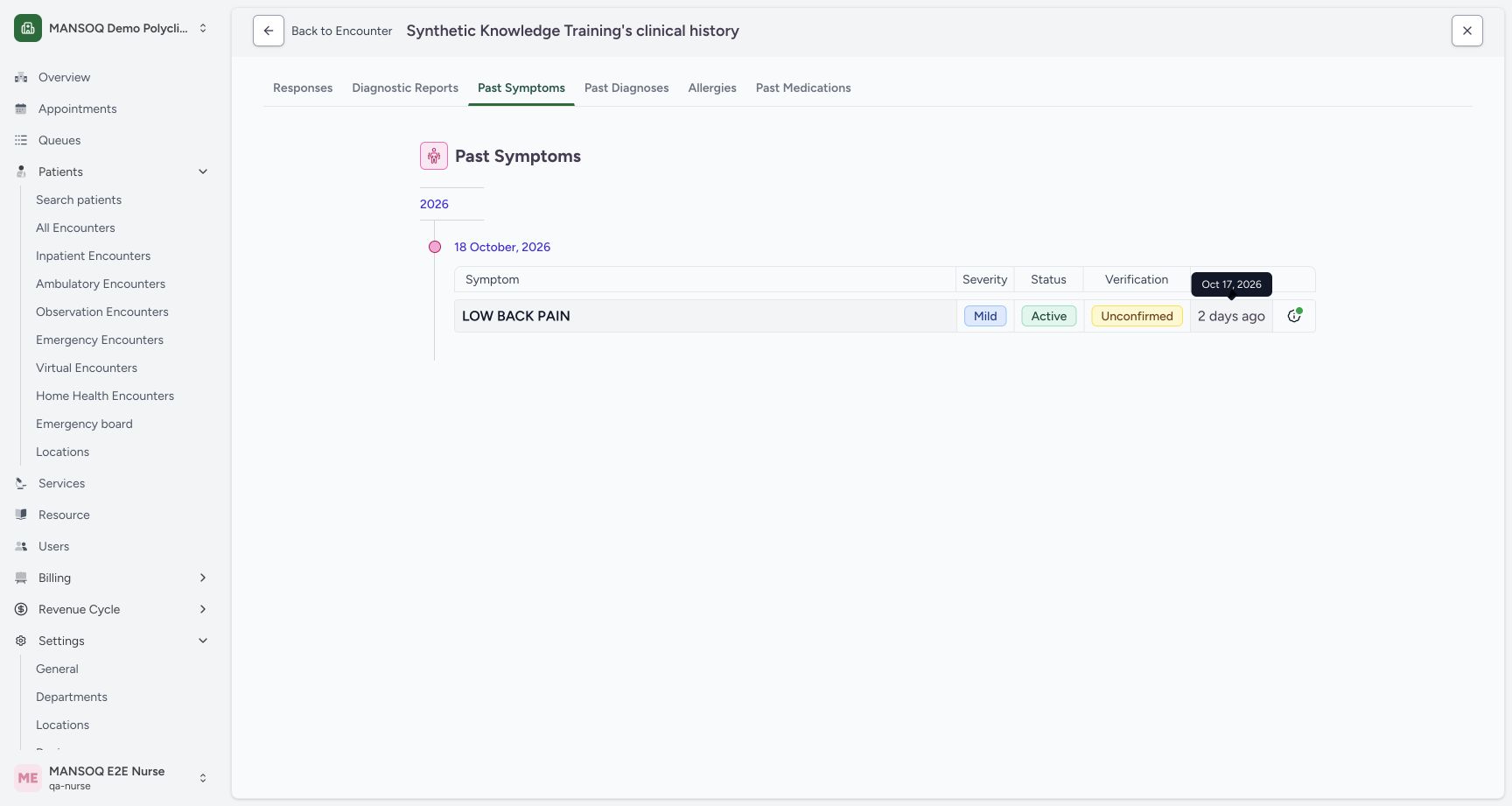 123
123Capture details
Actual Nurse in original pinned production UI, isolated synthetic active Inpatient encounter in a Polyclinic. One ICD-10-AM M54.5 problem-list symptom saved Active/Mild/Unconfirmed with fictional onset and note. No real patient assessment or treatment decision; two existing encounter diagnoses unchanged. This does not qualify every role, facility or symptom branch. Success: Patient-wide Past Symptoms groups record under18October creation date but onset relative text expands to17October2026. Independent READ ONLY confirms exact onset. Group date and onset are different facts.
- History group reflects record creation date: 18 October is the record creation group; it is separate from symptom onset.
- Open the exact onset behind the relative display: The relative time can be expanded to an absolute onset date.
- Exact onset is 17 October 2026: The tooltip shows the documented onset date.
The required term is not available
Use the facility’s configured terminology and approved support process. This guide’s term already existed and passed normal code validation; it does not demonstrate adding free text as an unvalidated code.
12Capture details
Actual Nurse in original pinned production UI, isolated synthetic active Inpatient encounter in a Polyclinic. One ICD-10-AM M54.5 problem-list symptom saved Active/Mild/Unconfirmed with fictional onset and note. No real patient assessment or treatment decision; two existing encounter diagnoses unchanged. This does not qualify every role, facility or symptom branch. Action: LOW BACK PAIN returns existing installed ICD-10-AM M54.5 concept. Normal ValueSet expansion and code validation passed; no new terminology or validation bypass was configured.
- Search the configured condition terminology: Search the configured condition terminology
- Choose the verified coded symptom: Choose the verified coded symptom
Source evidence
References are pinned to the private MANSOQ source repository. Repository access is required to open these links.
- repositories/platform/mansoq-web/src/components/Questionnaire/QuestionTypes/SymptomQuestion.tsx:90 · f6e9f05f
- repositories/platform/mansoq-web/src/components/Questionnaire/QuestionTypes/SymptomQuestion.tsx:360 · f6e9f05f
- repositories/platform/mansoq-web/src/components/Questionnaire/QuestionTypes/SymptomQuestion.tsx:696 · f6e9f05f
- repositories/platform/mansoq-core/mansoq/emr/resources/condition/spec.py:37 · f6e9f05f
- repositories/platform/mansoq-core/mansoq/emr/resources/condition/spec.py:61 · f6e9f05f